4.08.2012

love so amazing

(romans 5:8) 

  
in celebration of the resurrection, i bring you some of my favorite hymns to start your day.
  1. a 2 in 1: victory in jesus and power in the blood.
  2.   
  3. in christ alone.
  4.   
  5. jesus paid it all.
happy listening and happy easter!

    4.05.2012

    a baby belly and a lesson in biochemistry and molecular genetics

    i'm the type of person that likes to do research.  i like finding out facts and being well-informed before i make a decision...to understand the why and the how.  that's just my natural tendency.

    so naturally, when i first became pregnant i began doing my research.  not only was i searching for birth stories and experiences, but i wanted to know more about the scientific aspects of pregnancy...specifically labor and birth.  who knew you could learn so much amazing science just from being pregnant? thanks to pregnancy i've learned of the intricate, and well-timed scientific process your body goes through when you're in labor and why the "pain" during childbirth is actually normal.  a lesson in human anatomy and physiology, you might say, right?

    or how about a nice little lesson on microbiology when i tested positive for group B strep? and then there were the natural preventative measures i looked up in order to prevent the same thing happening while pregnant with cash.  you could consider that a quick study on naturopathic medicine.  right?  okay, maybe i'm stretching it a bit, but there is so much amazing natural science just within the scope of pregnancy and childbirth. 

    why bother with learning all this stuff?  like i said, i'm a girl that likes to make a well-informed decision.  it helps me find peace that the decision i'm going to make is the best one for me and/or my family.  and helps me get an idea of how my decision will impact the future.  that doesn't mean that i don't trust my healthcare provider, but i also don't see her as the ultimate decision maker in regards to the health and well-being of my body (this would apply to my children's pediatrician too).  i am ultimately responsible for my own health, including the decisions i make about the health and well-being of my body.  i suppose you could compare it to smoking.  smokers know the risk they're taking by smoking (it kills your lungs, there's an increased chance of lung cancer, etc., etc.), but does that stop them from smoking?  no.  does that mean that smoking is good for your health?  no.  most smokers are well-informed of the risks, but ultimately the choice to continue or stop is up to them.

    so now, baby number 4 is growing in my belly nearing the half-way point in my pregnancy.  what's new this time around?


    nothing much except that now i have developed the E antibody (or anti-E) in my blood.  what the heck is anti-E?  good question.  of course it's not one of those fairly common things that pregnant women get, so there's not much lay people information on it except what's found in forums (they have been quite helpful, though sometimes it's hard to tell what's fact and what's not).  what's left is a handful of medical journals i get to sift through to get a better understanding of what this means for me and the baby during the rest of my pregnancy.

    i did get a general explanation from my midwife and some very helpful friends (who's information i trust).  but did you think i would be satisfied with that?  ha!  of course not.  let me tell you i have been learning a lot about hematology, biochemistry and genetics.  not anything crazy in-depth like some kind of med student, but enough for me to take notes and draw pictures.

    so back to the big E. 

    what is it?

    you have to first get back to the basics of blood.  from my understanding, blood is made up of white blood cells, red blood cells and platelets.  within the red blood cells you have proteins and plasma.  then there are these molecules that hang out on the surface of your red blood cells.  they're called agglutinogens and there are 2 types: type A and type B.  that's what makes up your blood type.  if your blood doesn't have A or B then you have type O (or "zero" or the absence of A and B).  so that's where people have either these 4 blood types: A, B, AB or O.

    then there's the Rh protein (or the Rh factor) that hangs out on the surface of your red blood cells too.  you either have it or you don't.  that's where the + or - comes in with your blood type.  so for example, if you're blood type is AB+ then you have type A and B agglutinogens and have the Rh protein.  and all this blood stuff is genetic...and can affect whether or not you have a high-risk pregnancy.

    not to make things more complicated but the Rh protein is made up of these antigens: D, Cc, Ee (there are also the kell, duffy and kidd genes possible, but they're very rare).  and you can have a number of different combinations within the D, C and Es when you factor in the dominant and recessive genes.  if there are 8 possible combinations (CDE, CDe, CdE, Cde, cDE, cDe, cdE and cde) for each parent then you've got a nice little mix of possibilities for each child.  and when that child is grown and has his/her own babies there is another fun set mixing, and so on and so on (this site has a neat little table if you're a visual person)

    if you've ever been pregnant you've probably heard about the Rh factor in pregnancy, and what happens if you're a mom who is Rh-.  apparently, this Rh factor that's most commonly talked about during pregnancy only addresses the D antigen (RhD). so if you've ever gotten a rhogam treatment it was for the D antigen.  why only the D antigen?  because the others are uncommon and occur only in a small percentage of RhD cases.  of course it is (please add sarcastic tone to that statement).  the more i read, the more i understand that genetics is very, very complicated...even if it's only looking into the blood factor. 

    here's the interesting thing about blood types: your blood is picky.  if you receive a transfusion you can't just get any old blood type.  it has to be compatible with yours.  if you get an incompatible blood it's going to attack that "foreigner" by killing off the red blood cells and produce antibodies (similar idea to when you get sick).  the same thing applies to having babies.  blood type is a factor in your pregnancy experience.  if your blood type is incompatible with your baby's blood type (hemolytic disease of the fetus or newborn) then you could have issues.   

    now, i have never received a blood transfusion so the only other possibility of me developing the E antibody is through the exchange of blood types between me and one of my babies during childbirth.  it also means that my dear husband carries the (capital/dominant) E protein...which means that one (or some) of our 3 kids is carrying that same gene.  i, however, do not carry the capital E protein so when i was exposed to it, i developed the (capital) E antibody.  clear as mud?  of course.

    what's the next course of action?


    not much but pray :).

    i can't do a rhogam injection because that's only used to treat RhD.  i'll probably get titers done to make sure my big E levels don't get too high.  when it gets high, that's when it can cause fetal anemia (if the blood types cross paths) or super, worse (and very, very, very rare) case scenario of miscarriage, stillborn or hydrops fetalis.  however, it is possible to do an intrauterine blood transfusion if the fetus develops anemia.  after birth, the newborn baby will most likely develop jaundice because mama's blood has been trying to attack and break down all the baby's "foreign" red blood cells (most likely explanation as to why gibson and cash had jaundice, but emma did not). a lot of the information on how to handle anti-E requires medical intervention, which i am not a huge fan of.  obviously, when it's a medical necessity then i understand intervention is necessary. but i suppose it's important to first define what qualifies as medical necessity.  for example, there is a method via ultrasound that allows the baby to be monitored and checked for fetal anemia, which i think is a far better choice than the intrusive (and more high risk) amniocentesis.  but as we approach the birth of this baby, there will probably be other factors to consider, and we may have to consent to certain medical interventions that were not the norm during my other births for the health and safety of mother and baby.

    there's a 50/50 chance that the baby will carry the big E protein so it's hard to tell if there will be any "issues" at all.  most cases i've read, the worse and most common complication the babe experiences is jaundice.

    my only question, even after all this research, is why i can be Rh positive but still develop the E antibody.  is it because i don't carry the big E and just the little e, but maybe i carry a big D or C?  like i said before, genetics is very, very complicated.  any geneticists out there?  anyone?

    so...there you go.

    i know there hasn't been much updates with this pregnancy, but here's one "for the books."  ha!  quite frankly, i'm not worried, because i know the good Lord has it handled.  i feel like the information i've gathered has provided me with enough knowledge about the issue so that i'm not confused about it (especially when discussing this with my midwife).  i do want to put this information out there for any other mamas experiencing something similar since it's not something common experienced in pregnancy.

    ultimately, the outcome of all this is in the Lord's hands and i trust that he will work all things for good and for his glory.

    *****
    my search for anti-E led me to these places:

    4.04.2012

    wordless wednesday::girly-ness

    my girl and me embracing our girly-ness in matching skirts.


    more wordless wednesday here and here.

    3.16.2012

    getting off the fence - part 2

    we're in.  now what?

    i posted this video a while back on facebook.  it made me laugh.  but really.  he does bring up some good points.

    sometimes there are misconceptions about homeschooling.  and to be honest with you, before i did my research, i was guilty of having those same misconceptions.  the biggest one was socialization (isn't that the biggest question most people ask about homeschooling?).  they won't have any friends.  they'll be too isolated.  they'll be lonely.


    once i did more research, i could see that many of the things i perceived about homeschooling (including the socialization "issue") were unfounded, and it helped solidify our decision to homeschool.

    now, because i enjoy lists, instead of beautifully integrating our reasons to homeschool through out this post by way of eloquent sentences strung together seamlessly with transitional thoughts and word phrases, i will share with you our primary reasons why we're choosing the homeschool route.  in list form.  in no particular order.

    1. flexibility.  that was probably the most alluring aspect of home education for me.  you are flexible in how you teach, when you teach, how long you teach, and what you teach.  each child is unique.  an individual.  and the beauty of homeschooling is that you can teach in a way that's best suited for your child so that he/she can thrive and reach her full potential.  is your child really flourishing or showing an interest in a particular area? then run with it!  instead of stifling an interest because it's not according to the current curriculum (or you're running out of time), you can re-work your lesson plans to help encourage and nurture that interest.  or maybe your child needs extra attention in a particular area.  then take the extra time needed to help the child.  there's no need to rush through, because you aren't bound to any particular deadlines.  need to get away?  plan a family vacation and take a break from school to get refreshed.  who cares if you take "summer vacation" in the fall?  perhaps a month long break taken 3 or 4 times through out the year may work better than taking a straight 3 month "summer" break.  it all depends on the family, and the flexibility that homeschooling offers allows for an educational experience that's best suited for that particular family.

    2. spirit led. while i wouldn't say that we chose to homeschool solely for religious reasons, the decision to homeschool was made after prayerful consideration.  it wasn't something that we decided overnight, and we felt God really pulling us in this direction over time.  some people might think that families that choose to homeschool made the decision because of religion or to shelter our kids.  while those are important factors to consider, it was not the make or break reason for us to choose homeschooling.  God calls us to be a light in this world, and how that looks like for each individual (or families) will be different.  while i can see where homeschooling might prevent you from shining your light before others (families can be a light when kids are in traditional schools, allowing them to meet and come into contact with other families that come from many different backgrounds), there are many opportunities to be a light within the homeschool community as well.  there are homeschool groups you can be a part of (it doesn't always have to be a religious homeschool group).  the extra time you have left in the day "out of school" you can use to minister and reach out to the community around you.  while we strive to keep our kids from being exposed to things that they're not developmentally and/or emotionally ready for, it is impossible to keep them from all the "bad" things in this world (take them to a mall and you'll see pictures of scantily clad ladies, head to the playground and you might see some young adults involved in some intense tonsil hockey, you might even have loud neighbors who choose to drop the f-bomb and other profanities in every.single.sentence...).  i guess what i'm trying to say is that with any decision our family makes, we strive to make sure that it is the choice God wants us to make...and this includes how we educate our kids.

    3. secure individuals/balanced socialization.  i admit that lack of socialization was a big misconception i had about homeschoolers.  i didn't understand how they were supposed to hang out with other kids their age when they're going to school at home.  isn't it important to hang out with other kids their age and not spend all.day.long with their parents?  after reading this book, my views on the socialization issue (if it's even an issue at all) within home education changed.  a lot of the misconceptions i had about socialization as it related to homeschooled kids were addressed and clarified.  while there is nothing wrong with hanging out with other kids your age, i think a more accurate representation of real world situations would be having friends of various ages.  aaron and i have friends who are younger than us, older than us, and the same age as us.  the beauty of intergenerational friendships is that it offers a variety of learning opportunities for each other.  the wisdom of older, trusted friends are invaluable to me, and the optimism and energy that often comes with youth provides me with encouragement and a reminder not to take everything so seriously.  the book states that perhaps spending more time around kids the same age for 6 hours a day, 5 days a week (which makes up the bulk of the week) with limited adult supervision (1 teacher per 20 or so students or 2-3 teachers per 2-3 grade levels during recess for example), as opposed to spending the bulk of your week with the parents (who are supposed to be the primary role models for the kids), kids will begin to depend and be shaped more and more to the views and opinions of their peers instead of their parents.  now, i'm not saying that parents should brainwash their kids so that their views are exactly like your own.  but the book observes that usually, the kids in the traditional school settings end up loosing more of their individuality and desire more to conform to the other kids in order to fit in and feel included.  they choose to listen and follow the "wisdom" offered by kids their own age.  they then tend not to take the guidance and wisdom offered by their parents as seriously for fear of being excluded among their circle of friends at school.  i can totally relate to this observation.  looking back, i can see where that has happened, especially through my middle and high school years.  and having an oldest child who has been (and still is) in the traditional school setting for 10 years, we can see that happening in him too.  we want our children to be secure and safe with who they are as individuals.  but when our children spend the majority of time around other kids their age it can be challenging to encourage them to maintain their sense of individuality.  obviously, every child is different.  some kids won't ever be phased by what other kid think of them.  but there are other children who are perhaps more sensitive or impressionable, and putting them in a traditional school setting may provide more of an emotional challenge for them.  within the homeschool setting, there is plenty of time to socialize with other kids.  but the kids will be of varying ages and parents are close by to help re-direct, offer assistance or counsel when there is a tough situation.  children don't have to feel alone when they're encountered with a problem, because the parent(s) are easily accessible for guidance if needed.  obviously, we can't always be there for our children when they encounter a conflict or difficult situation, especially when they become adults, and it is healthy for them to reconcile and solve problems on their own.  but only when they are developmentally and emotionally ready to do so.  that's why they're children and not adults.  we cannot expect children to handle adult type situations with the same wisdom.  there is so much more interesting points to discuss when it comes to the socialization aspect of homeschooling, but this post isn't really about that.  whether you homeschool or not (or even if you don't have kids of your own), i highly recommend reading "the well-adjusted child" to give you a different perspective on kids and socialization.


    4. natural. the homeschooling choice fits into the other pieces of our lives so effortlessly (like i said in no. 2...we felt God pulling us in this direction and he had prepared the way for us to homeschool years before we made the decision).  we have a flow in our home.  a rhythm.  a balance.  choosing to homeschool for us did not disrupt that already established balance.  while there are days when i feel a little overwhelmed, or unmotivated, or both (i think that's normal for anyone to feel), homeschooling fits very well into the ebb and flow of our home, and the kids are happy (and i'm not pulling out my hair) and thriving.

    5. no standards.  the topic of standards, or more specifically standardized testings in schools has been a sore spot for me for many years.  i have seen first-hand how standardized testings can negatively affect students, teachers and schools as a whole.  i have seen how the results of standardized tests have affected the amount of funding a school receives so that the teachers there are struggling to find a balance in helping their kids succeed without compromising the quality of education they provide.  i've seen some teachers give up and just teach to the test.  i've seen schools cut arts programs in order to allow more time to teach the "more important" academics.  now, mind you, i'm not against taking tests, and i understand that a test can be a way to assess where a student is at in their studies.  but tests should be used as a tool, not the deciding factor on how a student ranks compared to other students or how a school ranks compared to other schools.  you can present "tests" in many different ways.  it doesn't always have to be the traditional-sit quietly-eyes on your own paper-timed kind of tests.  children are unique individuals.  not all kids are going to be successful in taking a seated, written-type of test.  if the dmv can test your driving skills by actually having you drive your car instead of merely testing your knowledge of driving through questions on a piece of paper, then why can't students in schools be offered those same options when it comes to getting "tested" on things that they've learned.  i could probably say more about my beef with standardized testings, but i'll stop myself there.  i'm thankful that when you choose to home educate you do have the option to by-pass the standardized testings and submit a portfolio for each of your homeschooled children.  less stressful for the child.  and less stressful for me.

    6. real life.  this point kind of goes back to no. 3.  if they're not spending 5 days a week for 6 hours a day at school, then they have that time at home to interact with each other.  that might sound like a time bomb waiting to explode, but from my personal observation i think the little ones are really getting to know each other.  going back to that ebb and flow in our home...i see that during the day.  they are starting to figure each other out and they're starting to figure out how to balance things out with each other.  yes, i might be home with them all day, but i don't jump in and intervene each time i have a conflict (isn't that like real life?).  i think those are valuable interpersonal skills they're developing.  not only that, but i think they're also developing their sense of personal space and knowing when and how to communicate their needs for time alone or time with others.  as they get older (and if we homeschool all the way up to high school), they will have more time to experience real living since their school time isn't going to take up the whole day.  the flexibility homeschooling offers can allow them to gain work experience (paid or unpaid), and really being out there in the community to see practically how things work without over-filling their schedules.  i also think they will really have a handle on the home management aspect of living (such as personal finance/money management, laundry, home maintenance, food and nutrition, etc.), since they will have had the chance to develop and master that fully at home without the additional burden of making sure school work is done (since home-related work/chores can count as schooling).


    i have to mention that my intent in writing this post is not to make anyone who sends their kids to traditional/conventional schools feel bad or guilty.  your child's education is your choice to make.  it's no different than if one family chooses to send their kids to a private school while another chooses to send their kids to public school.  we are choosing to send our kids home for school.  the big thing is being informed before making your decision.  the choice you make about your child's education should be one that best fits your family's lifestyle.  God designed and created each of us as unique individuals, and as a family no two are going to be the same.  likewise your choices as a family in matters of education, parenting style, nutrition, activities, etc. may look different from other families. and that's ok.

    the greatest thing we strive for as a family is to serve and glorify God with all that we do.  our choice to home educate is simply a practical way we can do that as a family.

    3.14.2012

    wordless wednesday::just wait a minute!

    seriously.  what happened to my little baby?

    but thanks to my wise 5 year old for this reminder: "it's a good thing you're having another baby!"

    thanks, kid.

    more wordless wednesday here, here and  here.

    3.07.2012

    wordless wednesday::husband edits

    this is my dear husband's version of editing photos...


    more wordless wednesday here and here.

    2.21.2012

    paczki, paczki!

    after living in cleveland for 6 years, i just recently discovered (and by recent i mean 2 weeks ago) this yummy little treat: paczki.

    what the heck is a paczki?  well, some might say it's a jelly doughnut.  but i say it's MORE than just a jelly doughnut!

    paczki (pronounced "punch-key" or "poonch-key" depending on where you find your information or who you talk to) is a traditional polish pastry.  they are pieces of dough, shaped into a flattened sphere, deep fried, filled with some sort of fruit or cream filling then sprinkled with powdered sugar.  traditionally, paczki was made in order to use up all the lard, sugar, dairy, eggs and all that sweet, rich stuff in the house, because they were not allowed to consume those things during lent.  paczki day in cleveland (and other large polish communities in the united states) celebrate paczki day on fat tuesday, since it is the day before lent.

    now, if you've seen my picture (or met me in person) you know i am not polish.  at all.  BUT, i married into the culture, thanks to my handsome husband.  last week, i had everything planned out to make homemade paczki.  after all, i can make a pretty mean pierogi so surely, paczki wouldn't be too far out of my league.  well, i woke up this morning feeling very behind on things.  and making paczki would just back log all the other stuff i want to do.  so i sent my polish-ish man (he's kind of a mixed breed...though that's not such a bad thing!) along with the kiddos to pick some up at rudy's strudel and bakery.


    and did they get the hook up thanks to the generosity of our sweet neighbor, lydia (who also happens to be the baker there).  a dozen paczki and an amazingly delicious looking lady finger.


    oh man, was it good.


    happy paczki day!

    2.15.2012

    wordless wednesday::a gathering

    the future UN delegation convene to discuss milk preferences and stinky feet...


    (countries represented: ethiopia, indonesia, and india)

    more wordless wednesday here and here.

    2.13.2012

    :: 12/12 ::

    my dearest, smallest, sweet boy,

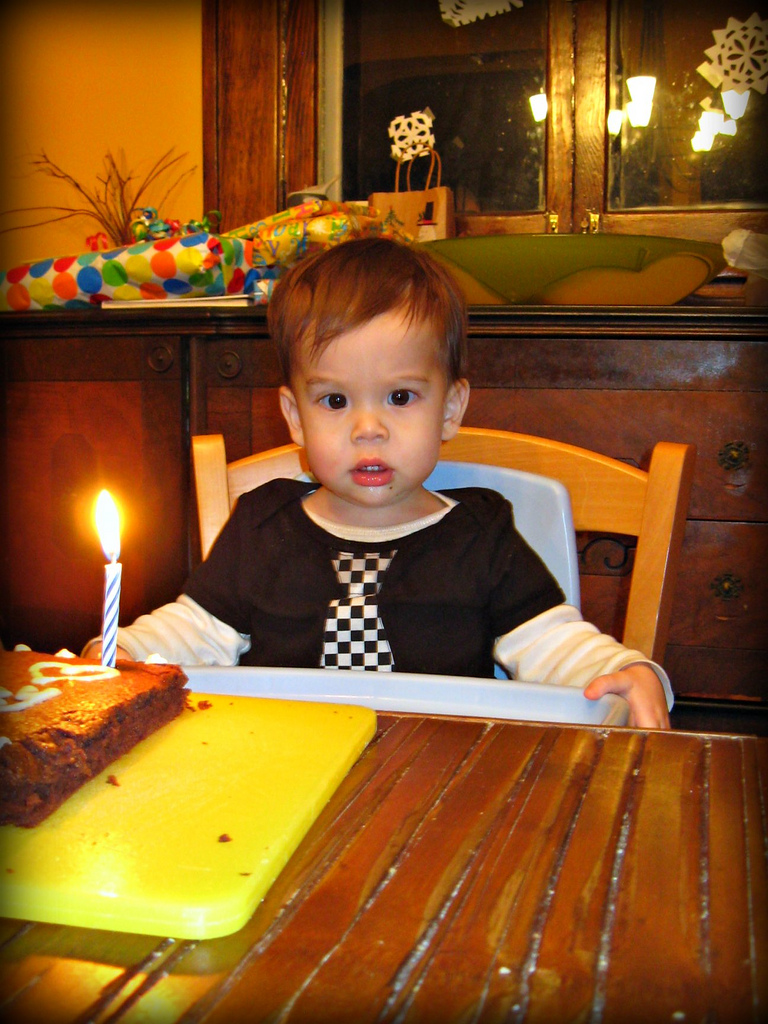
    yesterday you turned 1 year old.  wow.  even though i tried to enjoy every little moment and find ways to stretch time longer, the past year flew by.  again.

    while in some ways you are still a sweet, little baby, you are definitely turning into a more independent little boy (complete with little fits when you don't get your way).  boohoo for mommy.  fortunately, you still love to snuggle and give baby kisses!  and i love how sometimes you'll rest your head on my shoulder.  i will definitely miss that once you are too cool to snuggle with your mama.
    much like your older brother, you are beginning to enjoy discovering things.  and by discovering things i mean getting into everything, pulling stuff out and making a big mess.  we are now to the point where the gate at the bottom of the steps has come back up, because if we don't remember to put it up we can find you taking on those steps on your own.
    we shared your birthday celebration with our churches 5 year anniversary. 
    talk about the biggest 1st birthday party ever.  you were in the company of many, many friends and family.  it was so fun to be able to share in such a big birthday celebration.
     after some much needed beauty sleep, we enjoyed having some family members over for a small celebration of your 1st year of life. 

     there was lots of chocolate to be had, and you definitely didn't say no to that.
    you are much loved, baby cash.  and my prayer for you is that you will grow up to be a man who will love God and serve him with all your heart. 

    2.08.2012

    wordless wednesday::faces

    it's not always about the smiles in front of the camera...


    more wordless wednesday here and here.
    Related Posts with Thumbnails